
 Explore blog articles

co-ownership · 3 November 2025 – vivla
Why Co-Ownership Is the Future of Second-Home Real Estate
Co-ownership of a home is the legal arrangement in which two or more people hold registered title to the same property, sharing rights, costs, and use in proportion to each owner's share. In Spain it's governed by Articles 392 to 406 of the Código Civil (Royal Decree of 24 July 1889, BOE-A-1889-4763), recorded at the Registro de la Propiedad, and it creates a real estate asset that owners can sell, mortgage, lease, or pass on to their heirs under standard succession law.
That last part matters. Co-ownership is property, not a usage right dressed up to look like one. And once you grasp that distinction, the rest of the second-home market reads very differently.
This guide explains what the Spanish Civil Code actually says about co-ownership, how the model works in practice, where it diverges sharply from timeshare contracts under Spain's Law 4/2012, and why managed co-ownership has become the option of choice for owners who do the math on capital efficiency before buying a holiday home.
What does “co-ownership of a home” mean under Spanish law?
The Spanish Civil Code defines it in one sentence.
In plain English: community of ownership exists when title to an asset or a right belongs pro indiviso — undivided — to several people. In the absence of specific contracts, the rules of this title apply.
The key term is pro indiviso. You don't own “the kitchen and the bedroom on the right.” You own a percentage of the whole. If you hold 12.5% of a villa, you hold 12.5% of every square metre, every sunrise from the terrace, and every euro the asset produces.
It's real estate. Public deed signed before a notary. Inscription at the Registro de la Propiedad. Your name on record. The full regime is laid out in Articles 392 through 406, and it has governed shared real property in Spain since the Code was published in the Gaceta de Madrid on 25 July 1889.
Why “co-ownership” and “pro indiviso” mean the same thing
These are not two models. They are two names for the same legal figure. Pro indiviso is the Latin term still used in deeds and registry notes; “copropiedad” is the everyday Spanish. When three siblings inherit a beach apartment from their parents, what they technically hold is a comunidad pro indiviso under Article 392. Same legal animal. Different vocabulary depending on the room.
How does co-ownership of a property actually work?
Each co-owner holds a defined share — a quota — over the whole property. Under Article 393 of the Civil Code, profits and burdens are distributed in proportion to those quotas. If your share is 12.5%, you pay 12.5% of the property tax, the insurance, and the maintenance. You also have a right to 12.5% of any rental income or capital gain on sale.
Article 394 governs use: each co-owner may use the common asset “siempre que disponga de ellas conforme a su destino y de manera que no perjudique el interés de la comunidad, no impida a los copartícipes utilizarlas según su derecho”. Translated: you can use the property as long as you use it for what it's for, you don't damage the community's interest, and you don't stop the other owners from exercising their rights. That single sentence is the legal backbone of every booking calendar in every managed co-ownership scheme operating in Spain today.
That last article is the safety valve. It's why co-ownership is a flexible asset, not a trap.
Co-ownership vs. timeshare: not similar, not adjacent, not the same
This is the most expensive misunderstanding in the second-home market. And it's a deliberate one, fed by decades of marketing language designed to blur the line.
Co-ownership is a real property title. Your name appears in the Land Registry. The asset can appreciate, be sold at market value, mortgaged, leased, and inherited. It exists indefinitely. It's governed by Articles 392 to 406 of the Civil Code.
Timeshare — known in Spanish law as aprovechamiento por turno de bienes de uso turístico — is a contractual right to use a property for a defined period each year, for a defined number of years. You don't own the property. You own a usage right. The regime is governed by Law 4/2012 of 6 July 2012, which transposes EU Directive 2008/122/EC and replaced the earlier Law 42/1998.
A few practical consequences of that legal difference:
Timeshare operators built their marketing on the word “property” for thirty years. The law has been calling them out since 1998. The two models were never the same.
What does the second-home market look like in Spain?
The numbers matter because they explain why managed co-ownership emerged as a category.
By region, the share of households owning a second home varies sharply: 22.1% in Madrid, 21.8% in Aragón, 19.3% in the Basque Country, 18.5% in La Rioja. Coastal regions where one might expect higher concentrations — Balearic Islands (10.7%), Canary Islands (9.2%) — sit below the national average, because these are destinations, not origin markets.
The pattern reveals something obvious to anyone who has tried to buy a holiday villa in Mallorca or Ibiza: most of the demand for prime coastal property comes from somewhere else, primarily Madrid and a handful of capital cities. That demand is concentrated, capital-intensive, and chronically under-supplied at the high end.
That structural mismatch is what managed co-ownership solves.
How does managed co-ownership work in practice?
Managed co-ownership applies the legal framework of Articles 392 to 406 to a problem that classical co-ownership doesn't solve well: coordination cost. Three siblings can split an inherited apartment. Eight strangers buying a €2 million villa together cannot, not without a structure.
The model used by platforms such as Vivla works in five steps:
- The platform sources, vets, and acquires a prime property — typically in Mallorca, Ibiza, Formentera, Menorca, Baqueira, Marbella, or the Costa Brava.
- The asset is structured as a community of property under Article 392, divided into a fixed number of shares — usually eight.
- Each buyer signs a public deed before a notary acquiring one or more shares. The deed is inscribed at the Registro de la Propiedad.
- Each owner receives a fixed number of usage weeks per year — roughly 6 to 7 weeks for a one-eighth share — managed through a booking system that respects Article 394 of the Civil Code (equitable access for all co-owners).
- The platform handles all operational layers: maintenance, cleaning, calendar, check-in, insurance, utilities, and minor refurbishments. Fees are pro rata to ownership share.
The owner gets the legal status of a full property owner under Spanish law, the actual usage they would realistically have made of a wholly-owned second home, and zero operational overhead — the kind of overhead that turns most second residences into a part-time job.
Eight owners. Why eight?
The Civil Code sets no upper limit. Article 392 simply says “varias personas.” In practice, eight is the number that aligns three things: enough fractionalisation to bring the entry ticket below the level of a wholly-owned villa, enough usage weeks per owner (six to seven, after factoring in maintenance windows) to feel like a real second home, and a small enough group that Article 398 majority voting remains tractable.
Smaller fractions (1/12, 1/16) compress the usage. Larger ones (1/4, 1/6) push the entry price back up. Eight is the equilibrium most operators landed on by trial and error over the past decade.
Is co-ownership the right model for you?
If you plan to live in the property year-round, buy outright. The math doesn't favour fractional ownership for primary residences.
If your honest usage is 4 to 10 weeks per year — which is what most second-home owners actually use, however much they tell themselves otherwise — the relevant question is different: does it make financial sense to lock up 100% of the capital for 8% to 15% utilisation?
The answer depends on your goals, your liquidity, and your usage pattern. But the question is worth asking before, not after, the deed is signed.
Co-ownership vs. inheritance disputes: a word on real-world risk
Most co-ownership horror stories in Spain don't come from managed structures. They come from inherited pro indiviso situations where three or four heirs end up sharing a property none of them want to manage, no formal agreement governs use, and Article 400 ends up invoked in a Spanish court to force a división de la cosa común.
The legal framework is solid. The failure mode is governance. Managed co-ownership inverts the risk: the legal structure is the same, but the operating agreement, the booking system, the maintenance protocols, and the exit mechanism are all designed before anyone signs.
That's the actual product. The deed is the easy part.
Frequently asked questions
Official sources
- Código Civil español, artículos 392 a 406. Comunidad de bienes. Boletín Oficial del Estado. Consolidated text: boe.es/buscar/act.php?id=BOE-A-1889-4763
- Ley 4/2012, de 6 de julio, de contratos de aprovechamiento por turno de bienes de uso turístico. BOE núm. 162, 7 de julio de 2012: boe.es/buscar/act.php?id=BOE-A-2012-9111
- Ley 42/1998, de 15 de diciembre, sobre derechos de aprovechamiento por turno (derogada por Ley 4/2012): boe.es/buscar/act.php?id=BOE-A-1998-28992
- Directiva 2008/122/CE del Parlamento Europeo y del Consejo, de 14 de enero de 2009, relativa a la protección de los consumidores en contratos de aprovechamiento por turno.
- INE — Encuesta de Características Esenciales de la Población y Viviendas (ECEPOV) 2021. Datos definitivos publicados el 22 de febrero de 2023: ine.es/prensa/ecepov_2021_feb.pdf
- INE — Censo de Población y Viviendas 2021: ine.es
- Resolución de 4 de septiembre de 2025, Dirección General de Seguridad Jurídica y Fe Pública. BOE-A-2025-24794: boe.es/diario_boe/txt.php?id=BOE-A-2025-24794
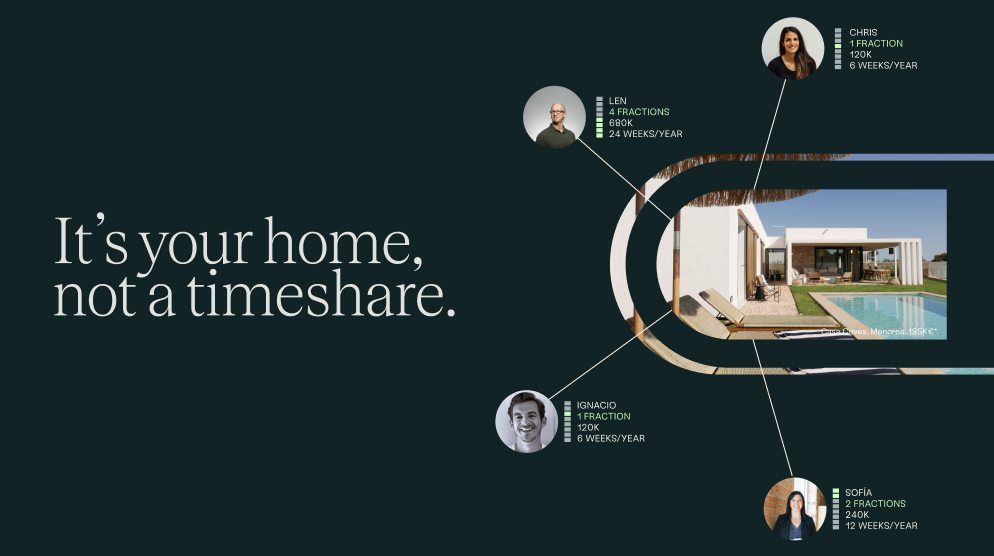

vivla co-ownership
Real ownership, a fraction of the cost
VIVLA offers managed co-ownership of luxury second homes across Spain — Mallorca, Ibiza, Menorca, Baqueira and many more. You own a registered share with a real title deed, not a use right, and VIVLA handles the purchase, the legal structure and year-round maintenance. It's the rational choice when you'll use the house a few weeks a year rather than the whole season.