
 Explore blog articles


11 October 2026 – vivla
What to Eat in Asturias: Dishes, Cider Houses and Markets
In Asturias you eat from a spoon and drink cider poured from a height. The essentials are fabada, pote, cachopo, fabes with clams and, in winter, oricios. Four cheeses carry a Protected Designation of Origin (Cabrales, Gamonéu, Afuega'l pitu and Casín), and since December 2024 Asturian cider culture has been on UNESCO's list of the Intangible Cultural Heritage of Humanity. October is a good month to start.
The dishes you can't leave without trying
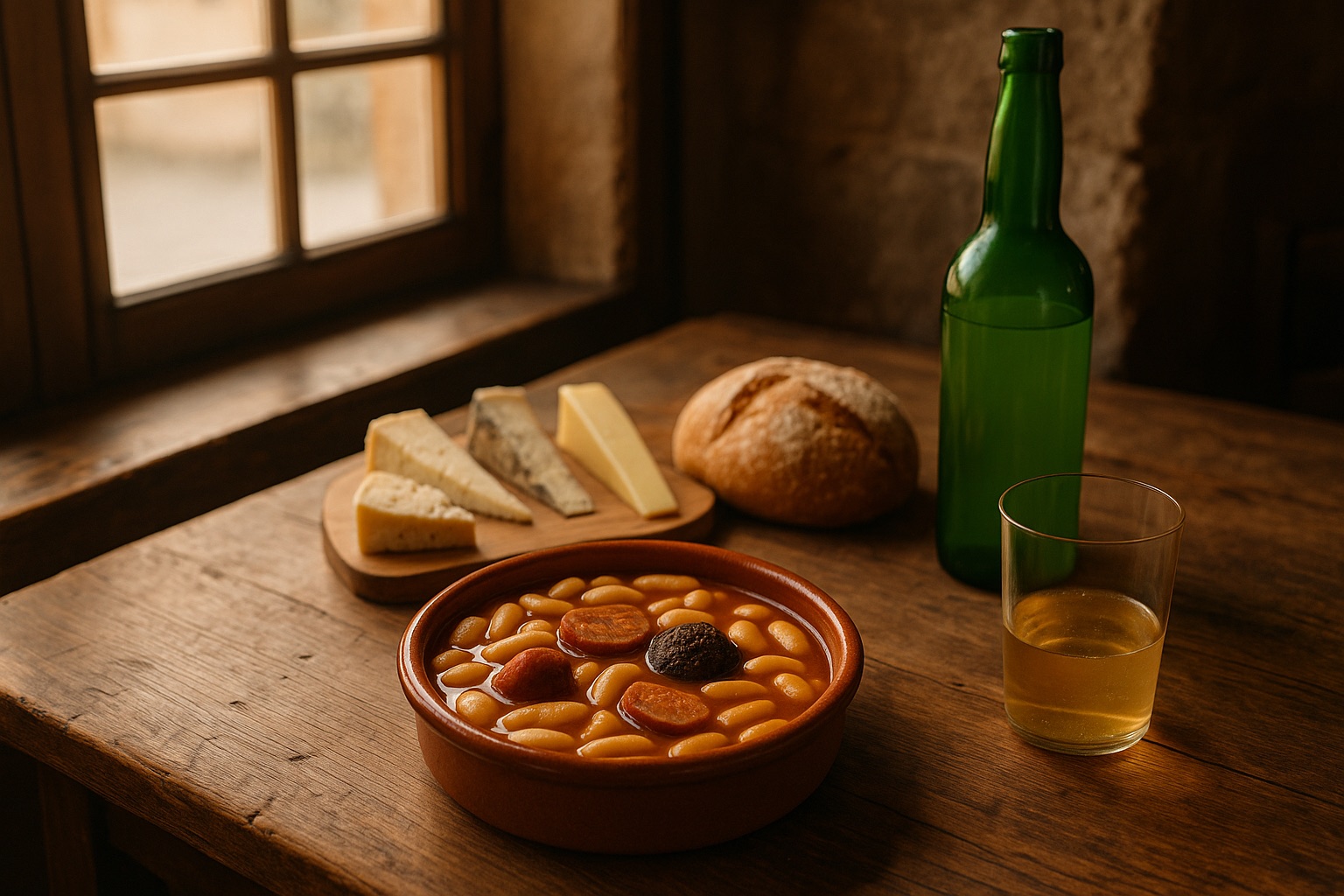
Fabada comes first. Turismo Asturias calls it the region's most emblematic dish. It is made with fabes, large white Asturian beans, stewed slowly with their compango, the cured meats that go in with them: chorizo, morcilla (black pudding), lacón (cured pork shoulder) and tocino (salt pork belly). You order it for lunch, never for dinner. And it tastes better on a rainy day than on a beach day. Pote is its everyday relative. It started out as a stew of cabbage and potatoes, with morcilla and chorizo added as and when there was something to add, and every valley makes it its own way: in central Asturias it has more cabbage and less potato.
Then there's cachopo. The classic recipe published by Turismo Asturias puts Asturian ham and cheese between two fillets of Asturian veal; the whole thing is then breadcrumbed and fried in very hot oil. It comes with potatoes and peppers. These days you'll find versions with almost any filling.
On the coast, fabada keeps different company: fabes with clams leave out the morcilla and chorizo and bring in clams, with white wine, garlic and saffron. The same sea gives pixín, the local name for monkfish; it's eaten griddled or in a caldereta, a fish stew, and it's good for most of the year. Oricios, or sea urchins, are another matter. They're eaten freshly opened, just as they are, mainly from December to March: their season is short and tightly regulated, according to Turismo Asturias. Gijón holds them in particular devotion.
For pudding, two fixtures. Arroz con leche, rice pudding, divides Asturians into those who want it requemado, with a caramelised crust, and those who don't; frixuelos, rather like a thin crêpe, are eaten as a dessert or in the middle of the afternoon.
Four PDO cheeses and one PGI
Asturias has five cheeses with a quality label: Cabrales, Gamonéu, Afuega'l pitu and Casín with Protected Designation of Origin status, and Beyos with Protected Geographical Indication status, according to Turismo Asturias. Each one has its own area.
- Cabrales. Blue and intense, made with raw cow's, sheep's or goat's milk, alone or blended, and matured in natural caves in the concejo, or municipality, of Cabrales, in the Picos de Europa.
- Gamonéu. Lightly smoked, with a little blue mould around the edges. It's made in Onís and Cangas de Onís in two versions: del puerto, made in mountain huts, and del valle, made in the valley.
- Afuega'l pitu. Made from cow's milk, either white or red if it contains pimentón (paprika). It comes from central Asturias: Grado, Salas, Tineo, Pravia or Cudillero.
- Casín. From the casina cow, a native breed, in the municipality of Caso, inside Redes Natural Park, and also in Piloña.
Beyos completes the list, from Ponga and Amieva in the east. If you like cheese, October is a good month to go: Benia de Onís holds the Certamen del Queso Gamonéu, its Gamonéu cheese fair, this year on Sunday the 25th.
How do you drink cider in a sidrería?
In a sidrería, or cider house, you order a bottle of natural cider and the waiter serves it escanciada, poured from a height, in culetes, small measures you drink in one go. The regulatory council of the Sidra de Asturias PDO explains why it's poured from so high: the bottle is held up above the head and the glass tilted below the waist, so the stream breaks against the rim and wakes up the carbonation. That culete, about 100 ml, is drunk straight away. If you wait, it goes flat. A bottle gives about six. Natural cider is served at 12 to 14 °C. Everyone has their own glass, but the bottle belongs to the whole table.
Not all the cider made in Asturias carries the designation of origin. To qualify, it has to be made only from Asturian apples of cider varieties (dessert apples are banned) and pass the council's checks. You'll recognise it by the numbered seal on the label: green for traditional natural cider and for filtered cider, black for sparkling.
There are 928 hectares of registered apple orchards, shared among 358 producers.
UNESCO inscribed ‘Asturian cider culture’ on 4 December 2024, at its committee session in Asunción (Paraguay), according to the Permanent Delegation of Spain to UNESCO.
If you happen upon an espicha, go. It's the party at the llagar, the cider mill, when the barrel is opened and the new cider tasted. Its season is spring. The biggest is Gijón's Primer Sidre l'Añu, the year's first cider, which in 2026 ran from 2 to 5 April with dozens of llagares from all over Asturias, according to the Turismo Asturias events calendar.
Villages where you eat well, from the estuary to the Picos
The Comarca de la Sidra, the cider district, is made up of six municipalities: Bimenes, Cabranes, Colunga, Nava, Sariego and Villaviciosa. Its two centres are Villaviciosa and Nava. Villaviciosa is where the pumaradas (apple orchards) and llagares are concentrated, and it's home to the regulatory council's headquarters. Nava keeps the Museo de la Sidra, the cider museum. Apples are picked in October and November, and some PDO varieties, such as amariega, ripen in the last ten days of October. At the mouth of the Villaviciosa estuary sits Tazones, a small port of low stone and timber houses. The young Carlos I came ashore there on 19 September 1517, and the village re-enacts the landing every 29 August.
Gijón is the city of the Primer Sidre l'Añu and the August festival. Cangas de Onís, at the gateway to the Picos de Europa, is the place for mountain cheese. Llanes and its villages, further east, have their own harbour, and Arenas de Cabrales, capital of the municipality that gives the cheese its name, is about 40 minutes' drive from Llanes. In the west, Cudillero has its houses hanging in an amphitheatre above the harbour. It also falls within the Afuega'l pitu area. In winter, the coast's summer resort villages slow down and some businesses close until spring.
Markets and food festivals with dates
Two markets deserve a morning. The one in Cangas de Onís sets up on Sundays from 10:00 to 15:00 beside the Palaciu Pintu and the church of Santa María, and it has been running for more than 200 years, according to Turismo Asturias. Local cheeses are on sale. Honey too. The other is El Fontán, in Oviedo's old town. Inside, in the market hall, you buy food. The square outside fills up mainly on Thursdays, Saturdays and Sundays.
The festivals, in calendar order:
On 25 October 2026, Benia de Onís holds the 46th Certamen del Queso Gamonéu. There's an open tasting and an auction of the prize-winning cheeses, and the tasting of Gamonéu with PDO cider has 20 places, with advance registration, according to the official programme. The day before, there's a romería, a traditional country fiesta.
In autumn, especially in November, comes the amagüestu: roast chestnuts and sweet cider, fresh from the llagar, at village fiestas all over Asturias.
July brings the Nava Natural Cider Festival, declared a Festival of National Tourist Interest, with its international cider-pouring competition.
At the end of August comes the Gijón Natural Cider Festival, which every year tries to break the world record for simultaneous cider pouring on Poniente beach.
Villaviciosa's Apple Festival is held every two years in October, and 2026 is not one of them.
Llanes as a base for eating your way round Asturias
In Llanes, VIVLA has Casa Torimbia, in La Galguera, a newly built villa with four bedrooms and a plot of more than 700 m², 3.5 km from some of the municipality's beaches. A 1/8 share costs 135,000 € (VIVLA listing, October 2026), with title deeds and six weeks a year.
You can see the Casa Torimbia listing or the Asturias destination page. If you're thinking of buying there, the guide to buying a house in Asturias compares villages, prices and climate.
Frequently asked questions
What is the most typical dish in Asturias?
Fabada. Turismo Asturias presents it as the region's most emblematic dish: fabes stewed with chorizo, morcilla, lacón and tocino. Pote and cachopo come next. It's hearty food, for midday. In the evening, a piece of cheese with a culete of cider is more appealing.
When is oricio season in Asturias?
Mainly in winter. Turismo Asturias places the main season between December and March, and warns that it's short and tightly regulated. They're eaten freshly opened, just as they are, and Gijón is where they're held in most devotion. If you go in summer, don't look for them.
Which Asturian cheese should I buy to take home?
It depends on what you like, but Cabrales is the easiest to recognise: a strong blue matured in caves. If you prefer something milder, go for Gamonéu, which is lightly smoked. The Sunday market in Cangas de Onís has Cabrales, Gamonéu and Beyos.
Why is cider poured from a height?
To wake up the carbonation so the natural cider reaches the glass fresh, according to the regulatory council of the Sidra de Asturias PDO. The stream falls from the bottle, held high above the head, to the rim of the glass. That's why only a little is poured and it's drunk straight away: after a few seconds it loses its sparkle.
vivla co-ownership
Real ownership, a fraction of the cost
VIVLA offers managed co-ownership of luxury second homes across Spain — Mallorca, Ibiza, Menorca, Baqueira and many more. You own a registered share with a real title deed, not a use right, and VIVLA handles the purchase, the legal structure and year-round maintenance. It's the rational choice when you'll use the house a few weeks a year rather than the whole season.
Related Articles
-
copropiedad · 13 November 2026 · 9 min
Co-ownership for beginners: what to know before you buy a home with VIVLA
read more -

destinos · 10 November 2026 · 7 min
The best ski schools for kids in Baqueira
read more -
destinos · 9 November 2026 · 7 min
Baqueira guide 2026-27: getting there, lift passes, ski areas and what to pack
read more