 Explore blog articles

destinos · 9 August 2023 – vivla
Luxury Homes in Mallorca: The 2026 Buyer's Guide
Mallorca's luxury home market in 2026 is no longer the holiday-home sideshow it was twenty years ago. It is now one of Europe's most established prime residential markets, with German, British, Scandinavian and increasingly American capital pushing prices in the southwest of the island past €7,000 per square metre. Engel & Völkers, the dominant agency in the Balearics with 35 years on the ground, recorded an average residential price of €4,673/m² in Q1 2026 — a 3.75% year-on-year rise that points to a mature, low-volatility market rather than a bubble. Over 50% of all transactions in 2024 closed at or above the €1 million mark.
This guide breaks the island down by zone, explains what each one actually sells, surfaces the regulatory shifts a serious buyer needs to know about, and finishes with a model — fractional ownership — that solves the asymmetry between what these homes cost and how much time most owners spend in them.
Why does Mallorca's luxury market keep growing?
Three structural forces explain why prices keep climbing: limited supply, internationally diversified demand, and protective regulation that constrains new construction.
On the supply side, Mallorca's coastline and most of its mountain ranges are protected. The UNESCO listing of the Serra de Tramuntana since 2011, the strict urban plans of the Consell de Mallorca, and the moratorium on new tourist licences mean that the stock of legally rentable and buildable luxury homes is essentially fixed. New builds at the top end are rare, hyper-priced, and absorbed in months.
On the demand side, the buyer pool is diversified across nationalities — German buyers historically dominate, the British market remained strong post-Brexit thanks to non-lucrative visas, the Scandinavian and Swiss segments expanded after 2020, and American buyers became visible from 2023 onwards as the dollar–euro dynamic and remote work normalised second-home purchases in Europe. No single market dominates, which removes the boom-bust risk that single-buyer dependencies create.
The result: Engel & Völkers' own price index shows Mallorca up roughly 73% over the last ten years, with average real returns of around 5% annually and no boom-bust cycle. Reiderstad Invest's 2026 base case forecasts a further 3–5% rise in average prices, with prime southwest and waterfront stock at 4–6%.
Where are Mallorca's luxury homes concentrated?
Mallorca's luxury inventory clusters in four distinct geographies, each with its own architectural language, buyer profile and price logic.
The Serra de Tramuntana — heritage and prestige
The Tramuntana is where Mallorca's most expensive trophy homes live. This UNESCO-protected mountain range runs along the northwest coast from Andratx to Pollensa, and the planning regime here is among the strictest in Europe. Towns like Deià (where Robert Graves lived for decades), Valldemossa, Sóller, Banyalbufar and Estellencs combine dramatic landscape with effective bans on new construction.
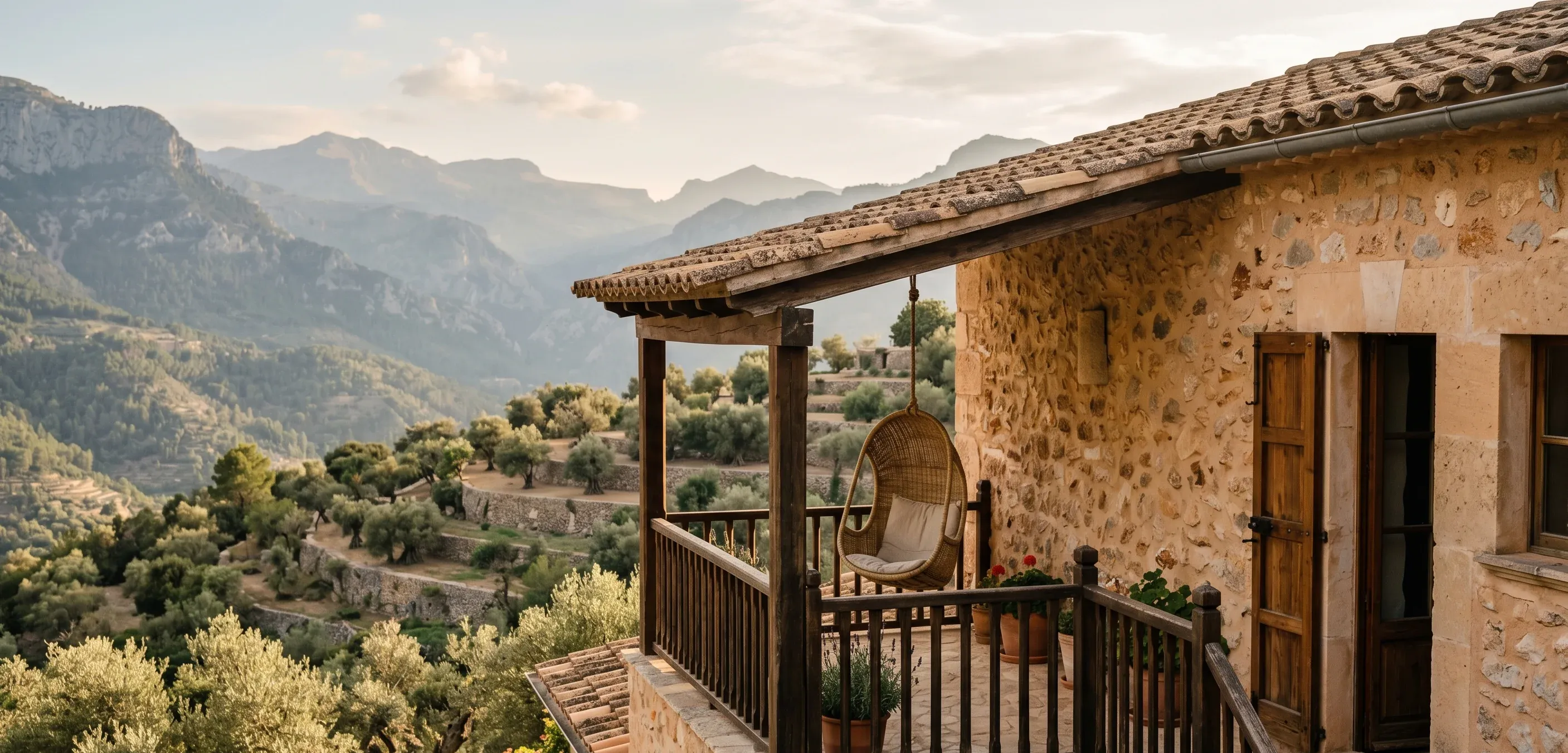
What you buy in the Tramuntana is rarely new. The signature property is a centuries-old finca — a working farmhouse — restored with contemporary interiors but preserving the original stone walls, sabina beams, terracotta floors and dry-stone terracing. These are the homes that command €5M+ regularly and that international magazines photograph. They are also the slowest market: low turnover, motivated sellers are rare, and broker relationships matter more than listing portals.
Sir Richard Branson's Son Bunyola hotel in Banyalbufar, opened in 2023, is the kind of signal that defines the area's positioning: ultra-luxury hospitality and residential converging on a coastline of 50 kilometres with maybe a few hundred prime homes.
The southwest — Andratx, Calvià, Bendinat, Portals
The southwest of Mallorca is the cosmopolitan capital of the island's luxury market and the zone where 2026 prices have moved most aggressively. Engel & Völkers tracks the corridor of Andratx, Calvià and Bendinat above €7,000 per square metre — significantly higher than the island average — driven by yacht-friendly infrastructure, proximity to Palma (15–25 minutes by car), and the international community that lives there year-round.
Port d'Andratx remains the marquee address: a deep natural harbour ringed by villas with direct sea views, restaurants at the level of Madrid and Barcelona, and a yacht traffic profile closer to the Côte d'Azur than to traditional Spanish coastline. Puerto Portals, fifteen minutes west of Palma, anchors the social scene with marina-front apartments and the highest concentration of luxury brands on the island. Bendinat and Costa d'en Blanes offer detached villas in gated communities with golf and sea views.
This is the zone where buyers prioritise turnkey: a recently built or fully renovated villa, smart home systems, a pool, a chef's kitchen, and the ability to land and live within 48 hours of closing.
Palma de Mallorca — the urban luxury bet
Palma is the only major Spanish city where you can buy a luxury home, dock a boat, and reach a UNESCO mountain range within twenty minutes. The old town has been transformed over the last decade: 17th- and 18th-century palacios converted into boutique hotels and private apartments, Michelin-starred restaurants (the island has 10 stars as of 2025), and direct flights to every major European capital from Son Sant Joan airport.
The luxury inventory in Palma splits into two products. In the historic centre — around La Lonja, El Born, Sa Calatrava and the cathedral — what trades are palace apartments with private patios, original stonework, and prices that have followed the southwest's curve upwards. In Son Vida, the gated golf community above the city, you find villa stock: large plots, mature gardens, panoramic views over the bay of Palma, and the highest concentration of expat permanent residents on the island.
Son Vida is also where contemporary new-builds with sustainable features and smart home technology concentrate — the segment of the market that Engel & Völkers identifies as growing fastest among buyers under 50.
The north — Pollensa, Alcúdia and the foothills
The north of Mallorca has a different rhythm. Pollensa and its port town are the family choice: longer beaches, a slower social scene, the Pollensa Festival (one of Spain's best classical music events, running since 1962), and a buyer profile skewed British and northern European. Prices are lower than the southwest but the inventory is higher quality on a per-euro basis, especially in the countryside between Pollensa and Sa Pobla — the foothills of the Tramuntana where traditional fincas sit on large plots with mountain and bay views.
Alcúdia adds the longest sandy beaches on the island and a Roman archaeological context that the southwest cannot match. For buyers whose use case is family-driven — children, sports, multiple weeks at a time in summer — this zone consistently outperforms expectations.
The east coast — quieter and undervalued
Calas de Mallorca, Porto Cristo, Cala d'Or and the eastern coast are typically overlooked by international buyers in favour of the more famous west and north. That neglect has kept the area authentically Mallorquín and arguably better value per euro spent. Working farms still operate, beaches haven't been resort-developed at the scale of the south, and homes feel rooted in the landscape rather than imposed on it. For buyers comfortable trading social density for authenticity, this is the smart play.
What's changing in Mallorca's regulation in 2026?
Three regulatory shifts shape the 2026 market and shouldn't be ignored.
First, tourist rental licences are frozen across most of the island. The Consell de Mallorca extended the moratorium on new licences in 2024, which means properties that already hold a valid ETV (Estancias Turísticas en Viviendas) licence trade at a premium of 10–20% over equivalent unlicensed stock. If your buying logic depends on rental yield, this is the single most important diligence question.
Second, the Tramuntana planning regime has tightened further. Renovating an existing finca is feasible, but expanding its footprint, adding pools, or building anything new requires multi-year permitting processes with high failure rates. Reputable buyers either purchase already-renovated stock or budget conservatively for three-year renovation timelines.
Third, the IRNR (non-resident income tax) and Spanish wealth tax (impuesto sobre el patrimonio) frameworks were both adjusted in 2024–2025 in ways that affect high-value second homes. The Balearic regional government applies its own wealth tax bonus, which materially changes the maths versus, for example, Madrid or Andalusia. A specialised tax advisor on the ground is non-optional for purchases above €1.5M.
How much does a luxury home in Mallorca actually cost?
The honest answer is: it depends on the zone, and the 2026 price floors are higher than most buyers expect.
A renovated finca in the Tramuntana with three to four bedrooms, a pool, and meaningful land typically starts at €3–4M and reaches €15M+ for trophy properties in Deià, Valldemossa or Estellencs. A turnkey villa in the southwest — Port d'Andratx, Bendinat, Son Vida — ranges from €2.5M to €10M+ depending on sea views, plot size and condition. A historic apartment in Palma's old town starts around €1.2M for two bedrooms and reaches €5M+ for the largest restored palace floors near the cathedral.
In the north, a traditional finca in the Pollensa countryside with land starts around €1.8M and the upper range is more compressed than in the south — call it €6–7M for the best stock. The east is the value play: comparable homes trade 20–30% below the equivalent in the southwest.
These numbers exclude purchase costs, which in the Balearics run to roughly 10–13% on top of the price: ITP (transfer tax) up to 13% on used homes above €1M, notary, registry, legal fees, and the Plusvalía Municipal where applicable.
What about fractional ownership in Mallorca?
For buyers who want a Mallorca address without locking €3M of capital into a home they use six weeks a year, fractional co-ownership has become a serious option in 2026. The model: a curated luxury home is held by an LLC (typically a Spanish SL), divided into eight registered shares, and each shareholder owns 1/8 of the property outright with rights to roughly 45 days of personal use per year.
Vivla is one of the operators that have made this category mainstream in Spain. The company already runs co-ownership homes in Ibiza, Menorca, Formentera, Costa de la Luz, Cantabria, Costa del Sol, Madrid and Baqueira, and Mallorca is a priority expansion zone for the team. Fractions in Vivla's existing portfolio currently start from around €140,000 for a 1/8 share in Cantabria up to €485,000 in central Madrid, which gives you a clean reference for what a Mallorca fraction will look like once homes go live on the island.
What you get with a fractional model is the asset (registered, sellable, appreciating), the address (curated villas in prime zones), and the absence of the operational drag — cleaning, maintenance, garden, pool, insurance, taxes — that makes underused second homes such poor uses of capital. What you give up is the right to use the home whenever you want and the right to redecorate it. For most buyers whose realistic usage is 4–6 weeks a year, the trade is favourable.
If a Mallorca home is on your radar but the full-ownership maths don't work, tell the Vivla team where on the island you'd want to be and they can walk you through what a fraction of a curated Mallorca property would look like.
vivla co-ownership
Real ownership, a fraction of the cost
VIVLA offers managed co-ownership of luxury second homes across Spain — Mallorca, Ibiza, Menorca, Baqueira and many more. You own a registered share with a real title deed, not a use right, and VIVLA handles the purchase, the legal structure and year-round maintenance. It's the rational choice when you'll use the house a few weeks a year rather than the whole season.