 Explore blog articles

destinos · 22 August 2023 – vivla
Madrid is the place to own a second home
Five years ago, the question "why Madrid?" was a fair one. Today, it's not. The capital has become one of the most dynamic real estate markets in Europe, attracting capital from Latin America, Northern Europe and the United States in volumes that didn't exist a decade ago. The reasons are structural, and they're not going away.
This article looks at why Madrid is now a serious answer to the question of where to own a second home — and why some of the most informed buyers in the world are voting with their wallets.
The macro story: Madrid's transformation since 2018
Several forces converged to reposition Madrid on the European map. The political and economic stability of Spain compared to other parts of Europe; the relative bargain on property compared to London, Paris or Amsterdam; the explosion of the Spanish startup and tech ecosystem; and a tax framework that has been notably friendly to high-net-worth individuals (the wealth tax exemption in the Comunidad de Madrid, in particular, has been a magnet).
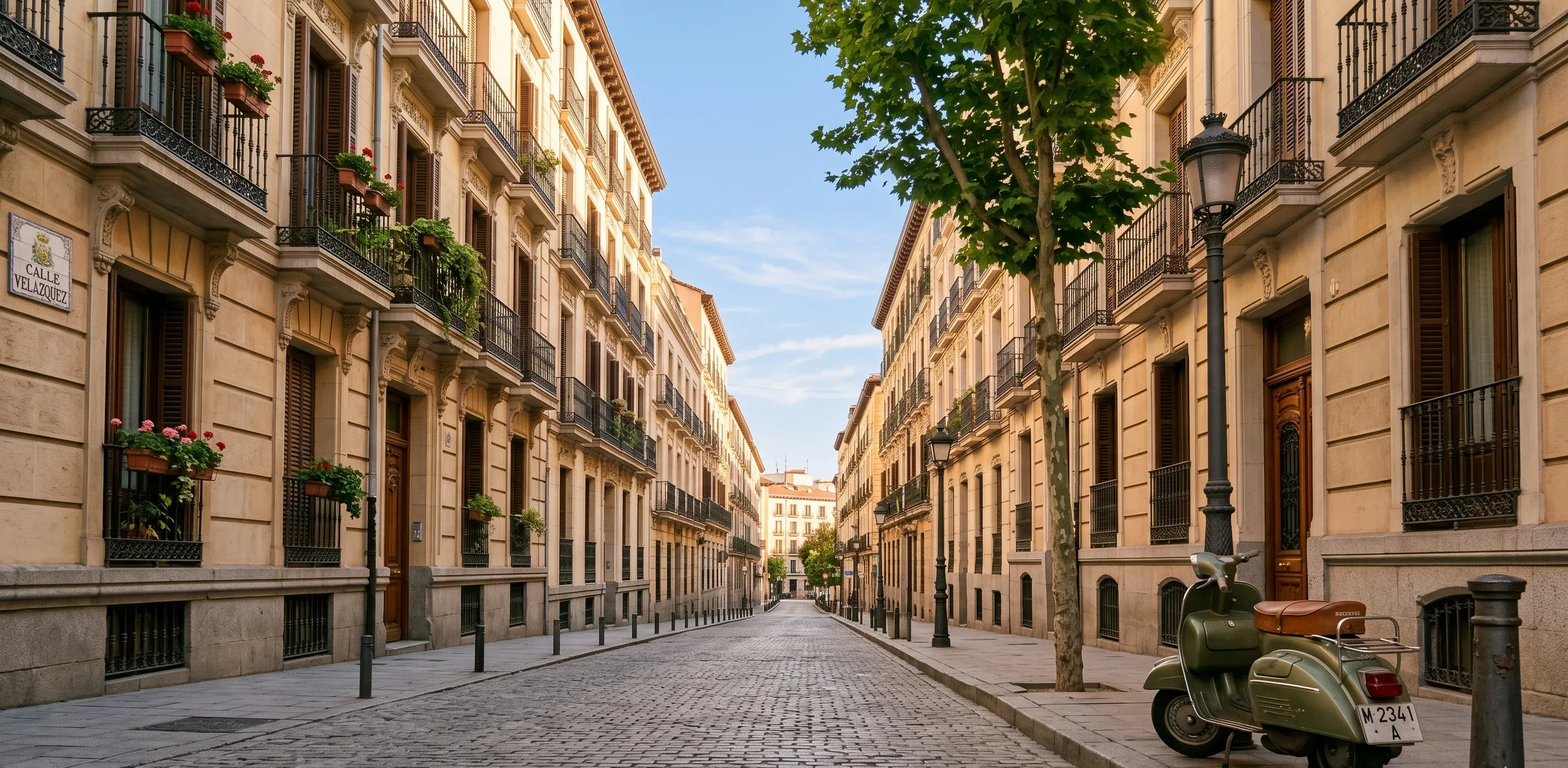
The result has been a reshaping of districts: Salamanca, Chamberí, Justicia and Almagro have been transformed by a wave of restoration and luxury retail; Las Letras and Lavapiés have become design destinations; and the city's restaurant scene has shifted from "good" to "world-class".
Why a second home in Madrid (and not just anywhere)
A second home in Madrid is a different proposition from one in Ibiza or Marbella. You're not buying for the beach. You're buying for everything else: culture, food, sport, family, business and the gateway to the rest of Spain.
The city has the highest density of museums in Europe (the Prado, Reina Sofía, Thyssen, plus a dozen others), restaurants that span every style and price point, the best Spanish football, opera, theatre and a calendar of cultural events that would take a decade to exhaust. And it's two hours from any beach, two hours from the mountains, and three hours from Lisbon, Barcelona and Seville by AVE high-speed train.
The neighbourhoods that matter
Salamanca
The most prestigious district. Wide streets, neoclassical buildings, Spain's most expensive retail (Calle Serrano, Calle Ortega y Gasset). If you want classic Madrid luxury, this is where it lives.
Chamberí
Salamanca's quieter, slightly more bohemian neighbour. Cafés, independent boutiques, a great restaurant scene and a residential feel that makes it ideal for long stays.
Justicia / Chueca
The cosmopolitan heart of central Madrid. Vibrant, walkable, with the nightlife and the energy.
Almagro
Quietly elegant, full of embassies and small literary cafés. One of the best places in the city for an evening walk.
Retiro
Adjacent to the city's most beautiful park, Retiro is the choice for families who want green space without leaving the centre.
What about the climate (the elephant in the room)?
Madrid has the strongest seasons of any major Spanish city. Winter is cold and dry; summer is hot and dry. The famous Madrid saying — "three months of winter and nine months of hell" — is a joke that locals enjoy because there's some truth to it.
But here's the upside: Madrid is empty in August. If you can structure your stays around the spring (March–June) and the autumn (September–November), you have one of the most pleasant climates in Europe — sunny, dry, mild — and the city at its best. Winter is brisk but lit by some of the longest hours of sunshine in continental Europe.
Buying a Madrid pied-à-terre with Vivla
Madrid is the kind of city where many international families want a place — but rarely use it more than a few weeks a year. That's exactly the case where fractional ownership shines: you get the address, the home and the lifestyle without the cost of a fully empty pied-à-terre.
If a Madrid second home is on your radar, explore Vivla's properties in the city's prime districts. We've curated apartments and townhouses in Salamanca, Chamberí and Almagro for owners who want Madrid as part of their life — without making it their whole life.
vivla co-ownership
Real ownership, a fraction of the cost
VIVLA offers managed co-ownership of luxury second homes across Spain — Mallorca, Ibiza, Menorca, Baqueira and many more. You own a registered share with a real title deed, not a use right, and VIVLA handles the purchase, the legal structure and year-round maintenance. It's the rational choice when you'll use the house a few weeks a year rather than the whole season.